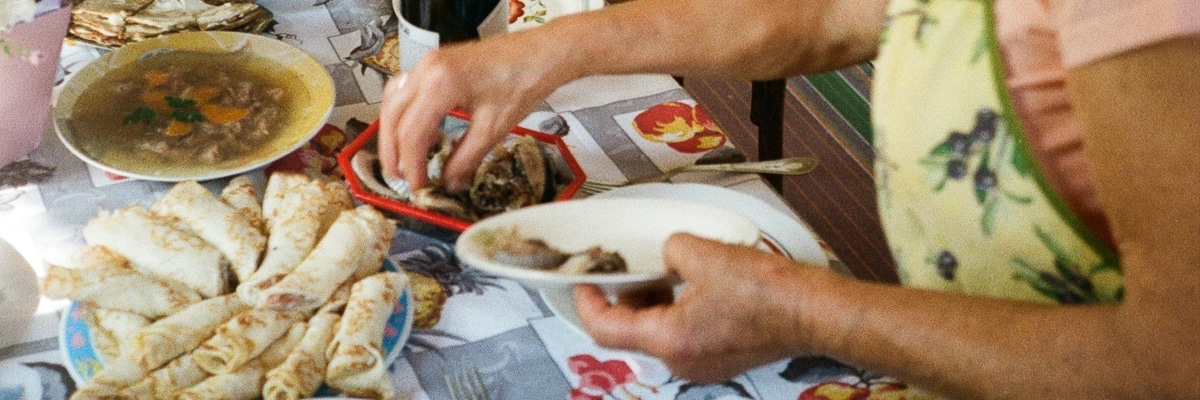
Father Richard understands Jesus’ eating habits as a model for the kind of inclusive and open hospitality Christians might practice.
God’s major problem in liberating humanity has become apparent to me as I consider the undying recurrence of hatred of the other, century after century, in culture after culture and religion after religion.
Can you think of an era or nation or culture that did not oppose otherness? I doubt there has ever been such a sustained group. There have been enlightened individuals, thank God, but seldom established groups—not even in churches, I’m sorry to say. The Christian Eucharist was supposed to model equality and inclusivity, but we turned the holy meal into an exclusionary game, a religiously sanctioned declaration and division into groups of the worthy and the unworthy—as if any of us were worthy! [1]
Before Christianity developed the relatively safe ritual meal we call the Eucharist, Jesus’ most consistent social action was eating in new ways and with new people, encountering those who were oppressed or excluded from the system. It seems Jesus didn’t please anybody by breaking rules to make a bigger table. Notice how his contemporaries accused Jesus: one side criticized him for eating with tax collectors and sinners (see Matthew 9:10–11). The other side judged him for eating too much (Luke 7:34) or dining with the Pharisees and lawyers (Luke 7:36–50, 11:37–54, 14:1). Jesus ate with all sides. He ate with lepers (Mark 14:3), he received a woman with a poor reputation at a men’s dinner (Luke 7:36–39), and he even invited himself to a “sinner’s” house (Luke 19:1–10). How do we not see that? [2]
It seems we ordinary humans must have our “other”! It appears we don’t know who we are except by opposition and exclusion. “Where can my negative energy go?” is the enduring human question; it must be exported somewhere. Sadly, it never occurs to us that we are the negative energy, which then sees and contributes to that negative energy in others. The ego refuses to see this in itself. Recognizing this takes foundational conversion from the egoic self, and most have not undergone that transformation. We can only give away the goodness (or the sadness) that we ourselves have experienced and become.
Eucharist is meant to identify us in a positive, inclusionary way, but we are not yet well-practiced at this. We honestly don’t know how to do unity. Many today want to make the holy meal into a “prize for the perfect,” as Pope Francis observed. [3] Most Christians still do not know how to receive a positive identity from God—that we belong and are loved by our very nature! [4] The Eucharistic meal is meant to be a microcosmic event, summarizing at one table what is true in the whole macrocosm: we are one, we are equal in dignity, we all eat of the same divine food, and Jesus still and always “eats with sinners,” just as he did when on Earth. [5]
References:
[1] Adapted from Richard Rohr, “Introduction,” ONEING 6, no. 2, Unity and Diversity, (2018): 13. Available in print and PDF download.
[2] Adapted from Richard Rohr, Jesus’ Alternative Plan: The Sermon on the Mount, 2nd ed. (Franciscan Media, 2022), 84–85.
[3] Francis, Evangelii Gaudium [The Joy of the Gospel], November 24, 2013, sec. 47.
[4] Rohr, ONEING, Unity and Diversity, 13–14.
[5] Richard Rohr, “A Welcoming Table,” Daily Meditations, January 25, 2022.
Image credit and inspiration: Anastasia Chervinska, untitled (detail), 2022, photo, Unsplash. Click here to enlarge image. Abundance is a table always set, where the meal awaits with quiet grace and there is always enough for all who arrive.


Story from Our Community:
I am part of a wonderful LGBT+ worship community called Open Table Liverpool in the UK. Many of us have read the Daily Meditations for years. More recently we now have a monthly gathering at a town pub which we call “A Pint with Richard Rohr.” Every month, we gather to reflect together on the past four weeks of meditations and our individual and community practice of contemplative prayer. It is such a deeply rich gathering of diverse folk from many Christian traditions and none, sexualities, and genders and we look forward to many more years of journeying together.
—Warren H.